What Is Chain Grade?
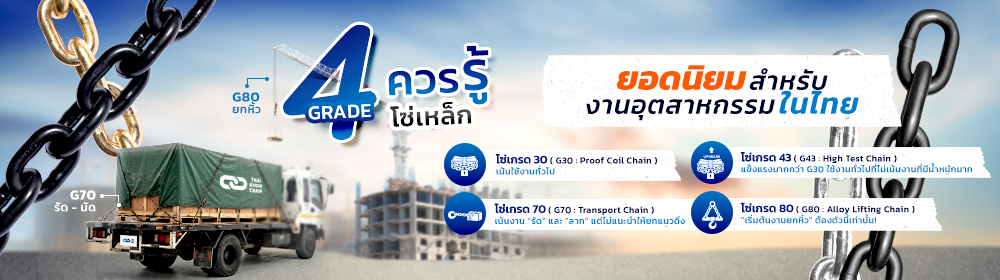
Chain grade refers to the mechanical properties and performance characteristics of a chain, which are influenced by its material strength, manufacturing process, and heat treatment.
A higher grade does not necessarily mean “better.” Instead, it generally indicates that the chain is designed for different applications and load requirements.
Chain selection should always consider:
- Type of application
- Required load capacity
- Operating environment
- Applicable project standards and specifications
Do not select a chain based solely on the lowest price. The appropriate chain grade should be selected based on safety, performance, application requirements, and applicable standards.
Comparison of Chain Grades
| Grade |
Key Features |
Typical Applications |
| G30 |
General-purpose chain |
Agriculture, barriers, general-purpose applications |
| G43 |
Higher strength than G30 |
Towing, machinery, marine applications, and heavier-duty industrial use |
| G70 |
Heat-treated, high-strength chain |
Load securement, cargo transportation, and trucking applications |
| G80 |
Alloy steel lifting chain |
Cranes, hoists, chain slings, and overhead lifting applications |
The above classification generally aligns with industry references, including ASTM and NACM standards.
G30 (Proof Coil Chain)
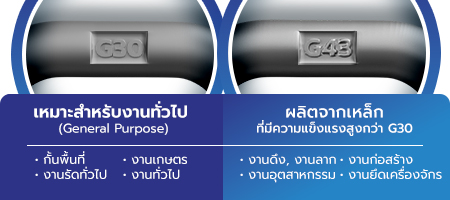
G30 chain is suitable for agricultural applications, barriers, general-purpose tie-downs, and light-duty industrial applications.
Advantages
- Cost-effective
- Versatile
- Easy to maintain
For outdoor applications, galvanized chains are recommended where additional corrosion resistance is required.
G43 (High Test Chain)
G43 chain is designed to provide higher strength than G30 chain.
Common Applications
- Industrial machinery
- Towing applications
- Marine applications
- Heavy-duty industrial applications (excluding overhead lifting)
Advantages
- Higher strength and load capacity
- Similar weight to G30 chain
- Suitable for demanding applications
G43 is commonly classified as High Test Chain and is intended for applications such as industrial, construction, towing, and general-purpose use. It is not intended for overhead lifting applications.
G70 (Transport Chain)
G70 chains are heat-treated to achieve higher strength and are commonly used for load securement and transportation applications.
Typical Applications
- Cargo securement
- Trucking and transportation
- Logistics
- Machinery transportation
- Heavy equipment towing
Advantages
- High strength
- Excellent strength-to-weight ratio
- Widely used for transportation and load-securement applications
G70 chain is commonly classified as a Transport Chain and is intended for applications such as cargo securement and transportation. It is not intended for overhead lifting applications.
G80 (Alloy Steel Lifting Chain)
G80 chains are manufactured from alloy steel and heat-treated to achieve the required mechanical properties for lifting applications.
Designed for
- Lifting operations
- Cranes
- Hoists
- Chain slings
- Overhead lifting
Advantages
- High load capacity
- High strength and durability
- Suitable for safety-critical lifting applications when used in accordance with the applicable standards and manufacturer's specifications
Grade 80 alloy steel chain is widely used for lifting applications. The appropriate chain grade, Working Load Limit (WLL), configuration, and lifting method must always be determined in accordance with the applicable standards, regulations, and manufacturer's specifications.
G30, G43, and G70 chains are generally not intended for overhead lifting applications unless the specific product is explicitly designed, rated, and approved by the manufacturer for such use.
How to Select the Right Chain Grade
Ask yourself these four questions:
- Is the chain intended for lifting or load securement?
- What load must the chain withstand?
- Will the chain be used in a corrosive environment?
- What standards or specifications does the project require?
If you are uncertain about the appropriate chain grade or application, consult the manufacturer or a qualified specialist.
Inspection Before Replacement Inspect the chain regularly and remove it from service if you find any of the following:
- Excessive elongation
- Excessive wear or deformation
- Cracked or damaged links
- Significant corrosion
- Missing, damaged, or unreadable grade markings
Do not continue using a chain that shows signs of damage or does not meet the applicable inspection criteria.
Summary
Although two chains may have the same size, their grade indicates differences in strength and intended application.
- G30 – General-purpose applications
- G43 – Higher-strength industrial and general-purpose applications
- G70 – Transportation and cargo securement
- G80 – Alloy steel lifting applications
Selecting the appropriate chain grade helps improve safety, support reliable performance, and reduce the risk of premature failure and unnecessary long-term costs.
Notes
- Chain grade indicates the strength classification and intended application of the chain. It does not replace the manufacturer's specified Working Load Limit (WLL), where applicable.
- For overhead lifting, always use chains, hooks, and other components specifically designed and rated for lifting. Follow the manufacturer's instructions and all applicable standards and regulations.
- Do not use chains with missing, damaged, or unreadable grade or identification markings in safety-critical applications.
- Always inspect chains in accordance with the manufacturer's recommendations and applicable standards. Chains showing excessive wear, deformation, cracking, or other damage should be removed from service.
References
- ASTM International – ASTM A413/A413M, Standard Specification for Carbon Steel Chain. This specification covers Grade 30 (Proof Coil Chain), Grade 43 (High Test Chain), and Grade 70 (Transport Chain) for applications other than overhead lifting.
- National Association of Chain Manufacturers (NACM) – Welded Steel Chain Specifications.
- National Association of Chain Manufacturers (NACM) – Forged Grade 30, Grade 43, and Grade 70 Chain Hook Specifications.
- THAI KOON CHAIN – Certifications.